Liselor Perez, « garde-robe », Paris
« garde-robe »
a solo show by Liselor Perez
with the support of CNAP - Centre national des arts plastiques
In the window of Sans titre, two dolls sit at a table. Behind them, a light veil marks the separation from the gallery space. The scene appears silent, almost motionless. Nothing indicates what is being said, or even whether anything is being said at all. The gaze passes through the glass, rests on the figures, then meets the fabric and the enclosed space. The intimate is made visible, yet filtered, held behind several layers.
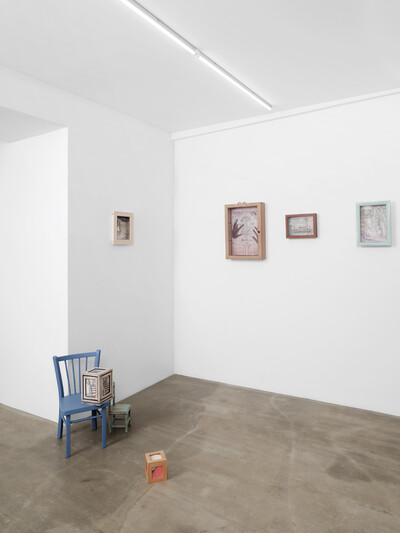
Liselor Perez constructs the exhibition as a succession of boxes. Cabinets, deep frames, miniature cupboards, enclosed devices, each acting as a container for drawings. Every image forms an isolated world. The spaces depicted do not communicate with one another. They coexist without meeting, separated by the walls that both protect and confine them. The act of containing becomes central: to store, to close, to frame, to compartmentalize.
The artist draws inspiration from miniature display cabinets, a practice whose earliest examples date back to the eighteenth century. They were often conceived as domestic pastimes, frequently practiced by women. These objects reproduced interior spaces with great precision: bedrooms, kitchens, cupboards and everyday life scenes. They testify to slow, attentive labor and sustained concentration. To reduce the house to the scale of a box is to take its measure, to become its sovereign observer. Yet it also means reducing intimacy itself, keeping it within a controllable perimeter. The home becomes manipulable. The household fits within the palm of a hand.
At the moment of drawing, however, something escapes simple reconstruction. The interiors do not remain intact. Hands appear at a scale that no longer corresponds to that of the room. They overflow the frame of a bathroom, slip between stacked cushions, or emerge inside a wardrobe. Within these reduced spaces, a fragment of reality remains at life size. The miniature thus ceases to be a closed world; it is crossed by a presence that exceeds it. These hands introduce a sensitive tension, at once bodily and mnemonic, as if memory itself refused to remain contained.
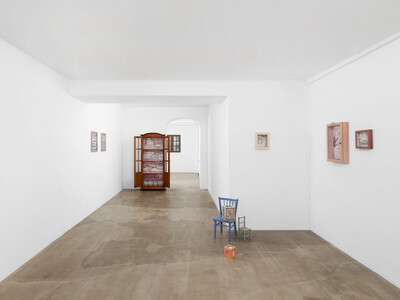
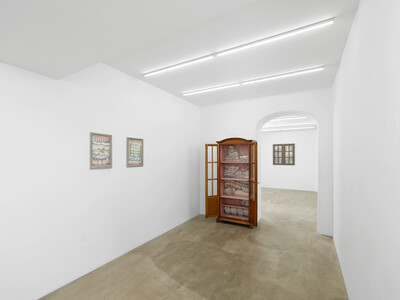
In the first room, miniature cabinets and vitrines accumulate around two chairs of different scales. The shift in proportion introduces a disturbance. Further on, a real wardrobe, at human scale, contains images that enlarge the miniaturized interiors. The gaze moves from reduction to enlargement. Scale becomes unsettled. No single format asserts itself as the norm. The visitor’s body becomes caught in this play, at times a giant facing the models, at times brought back to the dimension of a piece of furniture.
In the second room, a life size doll rests high above, placed on a shelf. Its body, sculpted in veneer wood, follows the logic of furniture. Its stomach forms a miniature cupboard, closed by small doors. It is both figure and piece of furniture, presence and storage. Facing it, a drawing depicts a building taking the form of a castle, blending into a forest and revealing a barely discernible face. The scene resembles a melancholic tableau, somewhere between reverie and nightmare. It could be what she sees, what she imagines, or what she has left behind. These two works establish a silent exchange, a barely suggested fiction charged with emotional tension. The doll is literally stored away, and its enforced stillness, its distance from the floor and from the viewer, reactivates relations of power linked to childhood, gender and social control.
The title garde-robe refers to a piece of furniture, a space of withdrawal, a place where clothing and personal objects are kept. Gaston Bachelard, in The Poetics of Space, describes cupboards, chests and drawers as intimate volumes, enclosed spaces where secrets and reveries accumulate. The cupboard is not merely a piece of furniture; it is an architecture of the interior. In the exhibition, bodies seem to align with this logic. They store themselves, fold inward, inhabit the frames that contain them. Reduction is no longer simply a play of scale; it becomes a condition of existence. The passive figures, often vulnerable, are not inert. They occupy the interstices, settle into the folds of wood, fabric and glass.
garde-robe does not merely show enclosed spaces; it tests their necessity. The boxes protect as much as they constrain. Inside them, something keeps watch, folds inward, waits.
—
Liselor Perez (b. 1999, Montélimar, France) lives and works in Paris. She graduated from the École nationale supérieure des Beaux Arts de Paris in 2025, where she studied in the studio of Dominique Figarella, after receiving her BFA from Villa Arson in Nice in 2022. In 2023 and 2024, she also took part in a ceramics exchange program at Tokyo University of the Arts (Geidai).
This year, the artist has been selected to participate in the residency program at Villa Dufraine. In 2025, she received the 5th Rubis Mécénat Prize, through which she benefited from the critical support of guest curator Julia Marchand and a production grant for an installation presented at Saint Eustache Church in October 2025.
In 2026, her work will be included in a group exhibition at the Zachęta National Gallery of Art in Warsaw. She will also be presented in the Statements section at Art Basel in June with the gallery Sans titre.
She has notably participated in group exhibitions at Frac Île-de-France, Romainville (2024), Palais des Beaux Arts de Paris (2025), La Supérette, Centre d’art contemporain de Malakoff (2025), as well as Sans titre, Paris (2023 and 2025).
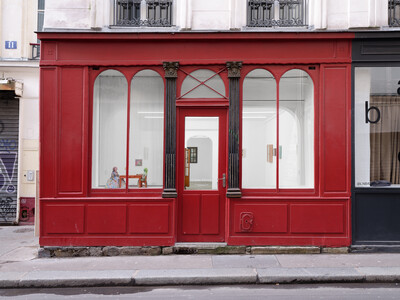
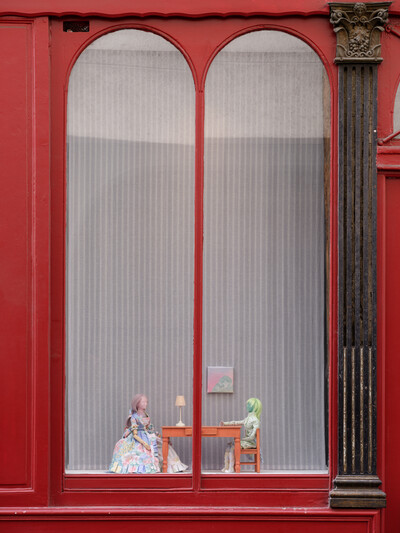
Liselor Perez, Mouchoir brodé (Kate et Kade), 2026, miniature furniture, silicone, synthetic hair, household linen, batting, wood, dollhouse lamp, variable dimensions, unique
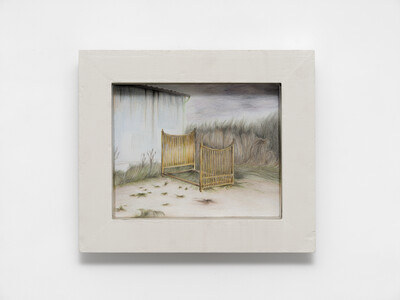
Liselor Perez, Plis, 2026, colored pencil on paper, miniature display case, 30.5 × 35.6 × 5.6 cm, unique
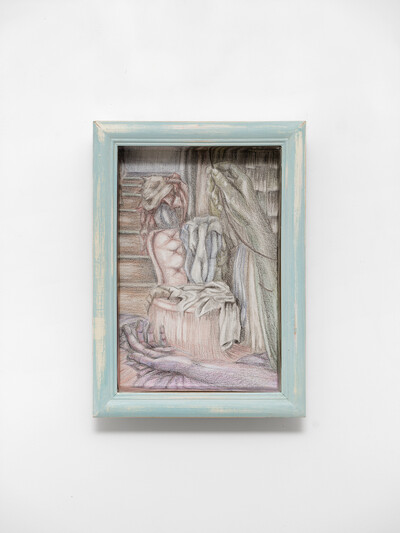
Liselor Perez, La bonnetière, 2026, colored pencil on paper, miniature display case, 35.7 × 25.8 × 6.6 cm, unique
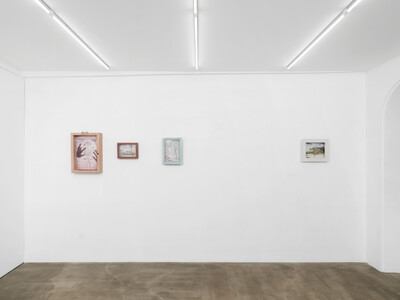
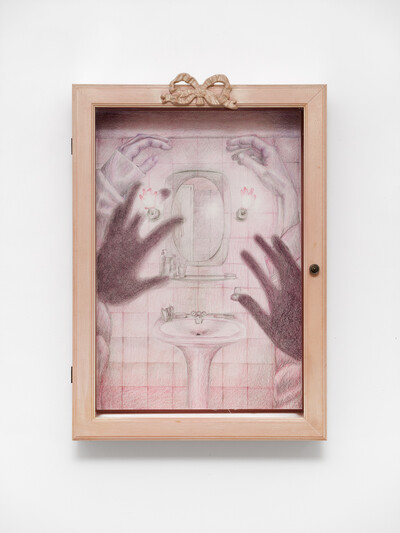
Liselor Perez, Depuis le miroir de ta penderie, 2026, colored pencil on paper, miniature bathroom display case, 55 × 38 × 11.5 cm, unique
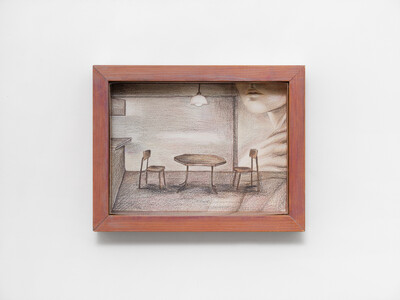
Liselor Perez, La malle, 2026, colored pencil on paper, miniature display case, 21.2 × 21 × 5.5 cm, unique
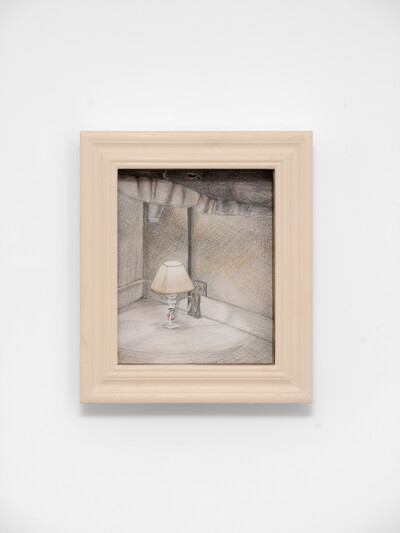
Liselor Perez, Épingle, 2026, colored pencil on paper, miniature display case, 29 × 24.6 × 5.3 cm, unique
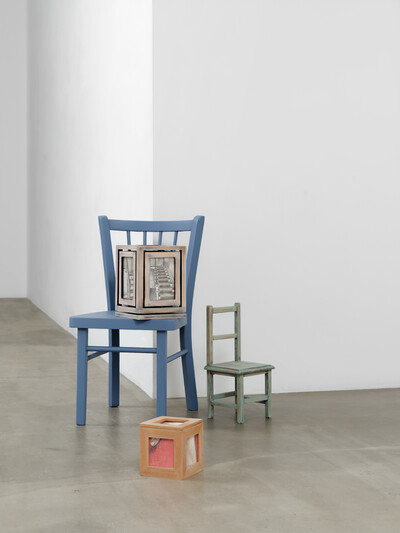
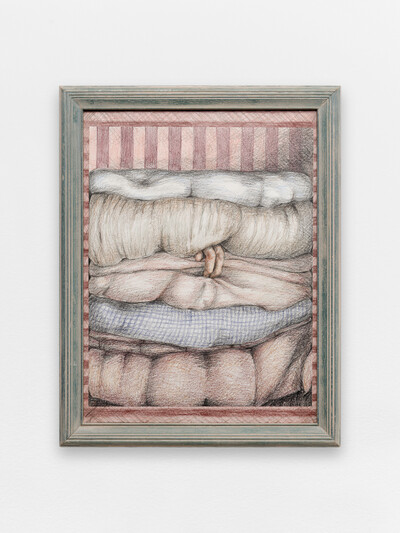
Liselor Perez, Au fond du tiroir, 2026, colored pencil on paper, wooden frame and glass, 45.5 × 35.1 × 2.2 cm, unique
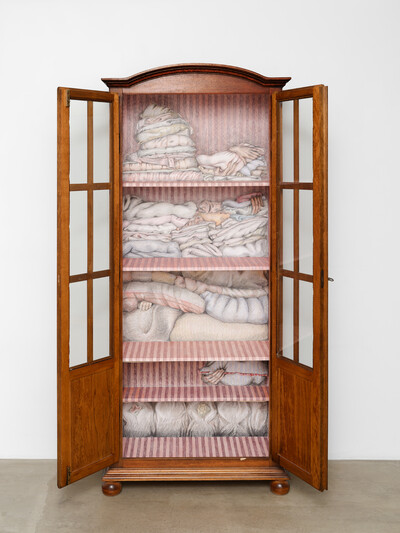
Liselor Perez, Un brin de lavande, 2026, colored pencil on paper, wooden display furniture, 180 × 60 × 40 cm (opened), unique
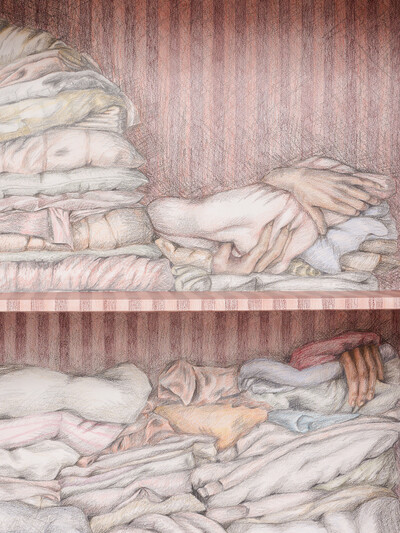
Liselor Perez, Un brin de lavande (detail), 2026
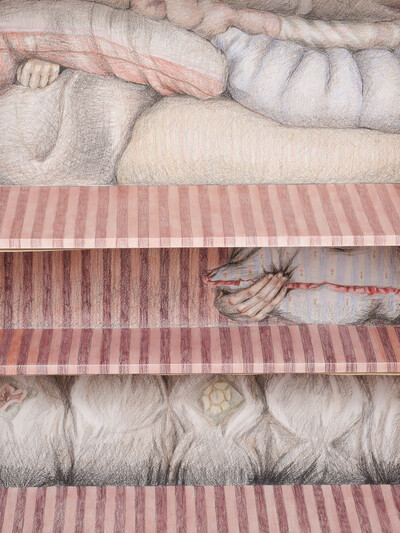
Liselor Perez, Un brin de lavande (detail), 2026
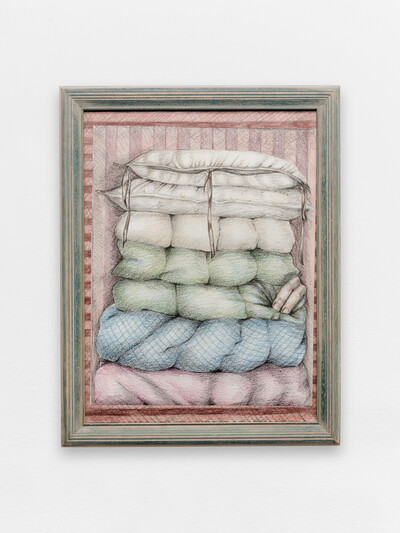
Liselor Perez, Revers, 2026, colored pencil on paper, wooden frame and glass, 45.5 × 35.1 × 2.2 cm, unique
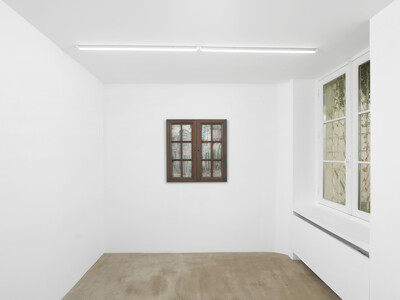
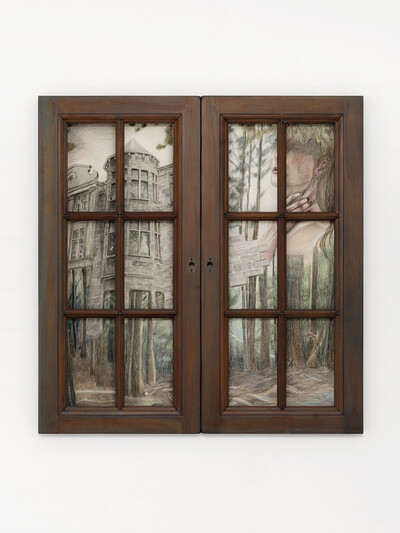
Liselor Perez, Sous la pile de linge, 2026, colored pencil on paper, bookcase door, wood, 94.4 × 90.4 × 4.2 cm, unique
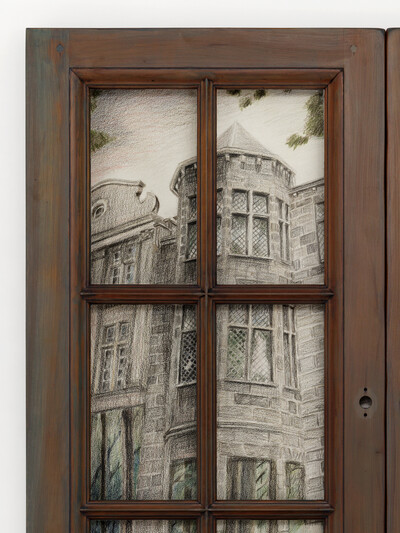
Liselor Perez, Sous la pile de linge (detail), 2026
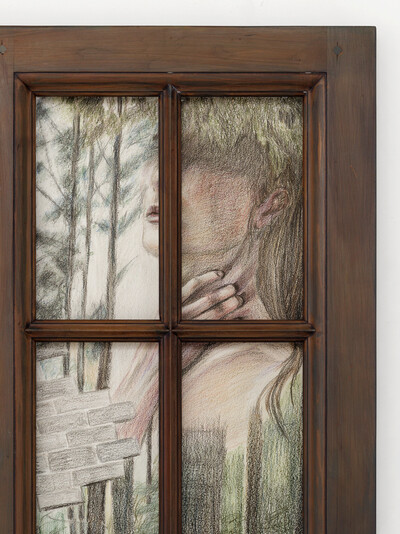
Liselor Perez, Sous la pile de linge (detail), 2026
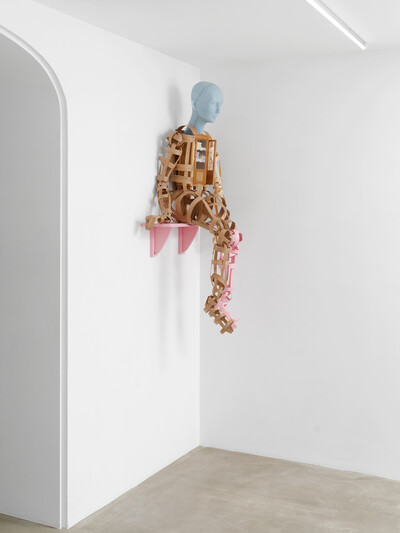
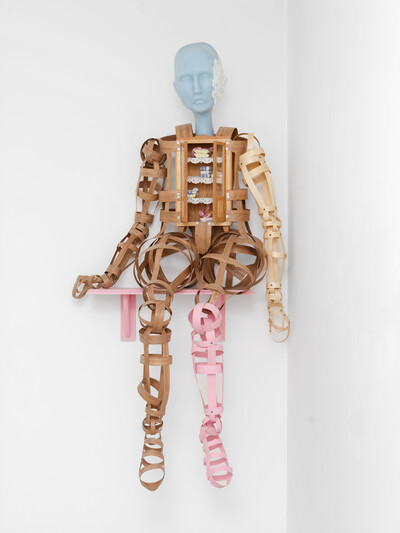
Liselor Perez, Chiffonière, 2026, silicone, batting, veneer wood, wood, rivets, miniature display case, shelf, 145 × 80 × 50 cm, unique
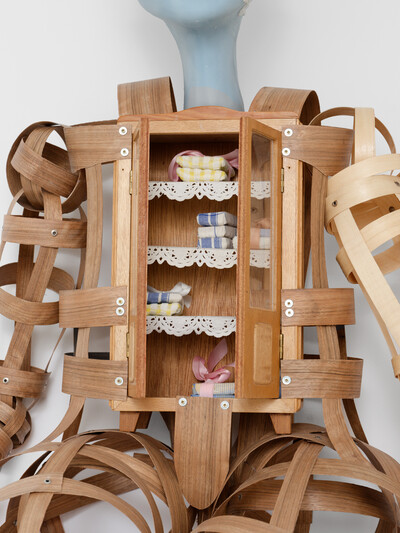
Liselor Perez, Chiffonière (detail), 2026
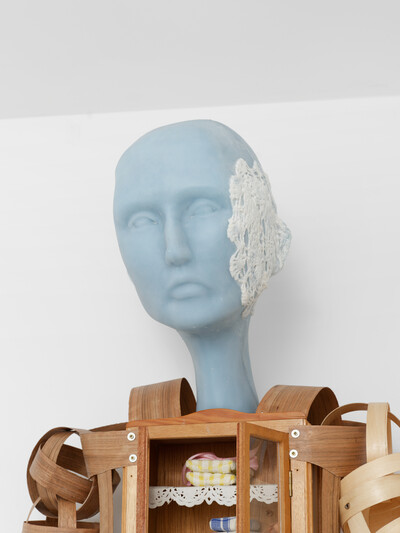
Liselor Perez, Chiffonière (detail), 2026