Ezio Gribaudo, « D come Dinosauri », Milan
« D come Dinosauri »
a solo show by Ezio Gribaudo
Casa MB, Milan
Conceived within a broader constellation of exhibitions unfolding across Paris, Venice, Milan and Turin, this project takes part in a collective moment of recognition: sixty years after Ezio Gribaudo was awarded the First Prize for Graphic Arts at the 33rd Venice Biennale (1966). Rather than approaching this anniversary through a retrospective or commemorative logic, the exhibition focuses on a singular and persistent motif within Gribaudo’s practice — one that gradually emerged as a recurring figure, almost a totem: the dinosaur.
If these creatures appear at first as distant echoes of prehistory, their presence in Gribaudo’s work is neither illustrative nor descriptive. They belong instead to a broader system of forms that the artist continuously developed across decades, shaped by his unique position at the intersection of artistic production, publishing, and visual circulation. Forms, in this context, are never fixed. They are generated, displaced, translated — moving between techniques, supports and scales, from paper to sculpture, from imprint to volume.
The origin of this body of work can be traced back to a decisive moment. In 1984, during a journey in Australia, Gribaudo encountered fossil remains near Alice Springs. This experience did not result in a documentary impulse, but rather in the activation of an imaginary. The landscapes presented in the exhibition stem from this encounter — not as faithful depictions, but as filtered recollections, where observation is inseparable from reconstruction. From that point onward, the dinosaur became a persistent figure in his work, evolving across media and contexts, as if returning in different forms, never entirely resolved.
These creatures do not belong to a stable temporality. Already known through museums, reconstructions and cultural projections, dinosaurs exist in a condition of mediation. Gribaudo embraces this distance. His dinosaurs are not representations of animals, but images of images — forms that emerge from layers of memory, reproduction and imagination. In this sense, they operate less as subjects than as vehicles through which the artist reflects on how knowledge is constructed and transmitted.
Throughout his career, Gribaudo maintained a constant engagement with processes of printing and publishing, working in close proximity to major figures of the twentieth-century avant-gardes. This proximity was not a matter of influence in a traditional sense, but of circulation: images passing through hands, pages, plates, matrices. Such a context deeply informed his understanding of form — not as an original entity, but as something inherently reproducible, transformable, and unstable.
This logic extends to the exhibition itself, which unfolds as a fragmented ensemble rather than a unified narrative. The works coexist as distinct yet interconnected elements, forming a visual ecology where scale, material and representation remain in tension. The dinosaur, in this constellation, appears simultaneously monumental and intimate, familiar and estranged — a figure that resists resolution.
At once archaic and constructed, distant and immediate, these forms persist as traces of something that can no longer be directly experienced. They evoke a world reconstructed from fragments — where memory, imagination and material processes intertwine, and where the past continues to take shape in the present.
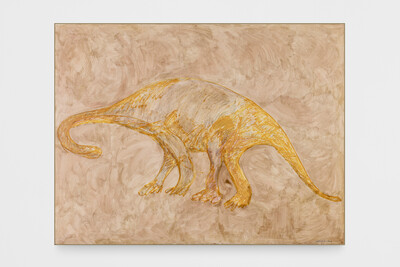
Ezio Gribaudo, Sauropode, 1984, mixed media on mounted paper, 122 × 160 cm, unique
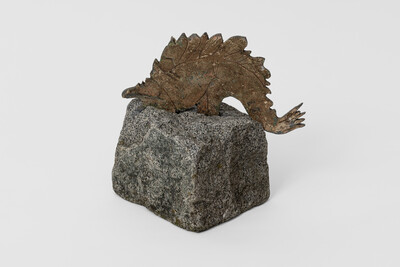
Ezio Gribaudo, Stegosauro, 1984, lead, antimony, stone, 20 × 15 cm, unique